Resources
Reps, Feedback, and the Confidence We’re Building
Unstuck Monthly | December 2025
What makes someone confident in one area of life and paralyzed in another?
As we close out the year, I've been sitting with a question: why do some people trust themselves in one area of life but not another?
I’ve been thinking about this because of a client I worked with recently. In athletics, he’s confident. He picks training partners who push him, tracks his progress, and when someone says he can’t do something, he sets out to prove them wrong.
At work, he’s paralyzed. He doubts himself constantly and avoids risk. He operates by a motto he’s carried since childhood: “It's easier to not try than to try and fail.”
Same person. Completely different relationship with confidence.
Confidence Isn’t a Trait. It's a System.
When I asked what made athletics different, my client’s answer was simple: he gets reps, he gets feedback, and he can see himself improving. At work, none of that exists.
This tracks with what psychologist Albert Bandura found in his research on self-efficacy. Confidence isn’t a fixed trait we either have or don’t. It’s built through specific inputs:
Mastery experiences. We try something, it works, our brain updates its model of what we’re capable of. This is the most powerful input. Reps build confidence.
Feedback from trusted sources. When someone we respect tells us we’re on the right track, it matters. When no one says anything at all, doubt fills the void.
Watching others succeed. Seeing people like ourselves accomplish something makes it feel possible for us. This is why representation matters and why our peer group shapes our sense of what’s achievable.
How our body feels when we try. Anxiety, exhaustion, and stress all send signals that get interpreted as “this is too hard” or “I’m not ready.” Physical state shapes confidence more than most of us realize.
When these inputs are present, confidence compounds.
When they’re absent, it erodes.
Feedback Matters More Than We Think
Here’s where the neuroscience gets interesting. Dopamine, the chemical most people associate with reward, is critical for our ability to predict and learn. When we take action and get clear feedback, our brain calibrates: “That worked, do it again” or “That didn’t work, adjust.” The loop closes. We learn.
When we take action and get silence? The loop stays open. Our brain doesn’t know what to do with the data. Over time, the signal shifts from “try again” to “why bother.”
This is why a feedback void is so corrosive. It’s not neutral. Silence doesn’t mean “we’re fine.” It means the system that builds confidence has broken down.
A quick aside for those who manage others: Feedback is one of the most important things you owe the people who work for you. Not vague praise. Not softened critiques. Real, usable signals that help teammates and colleagues calibrate and grow. If you’re not providing it, someone else’s confidence is eroding in the silence. |
What This Means for the Year Ahead
When our confidence has taken a hit, the fix isn’t to feel better first and then take action. It’s the reverse. Confidence is the result of action, not the prerequisite.
But not just any action. Action with the right inputs:
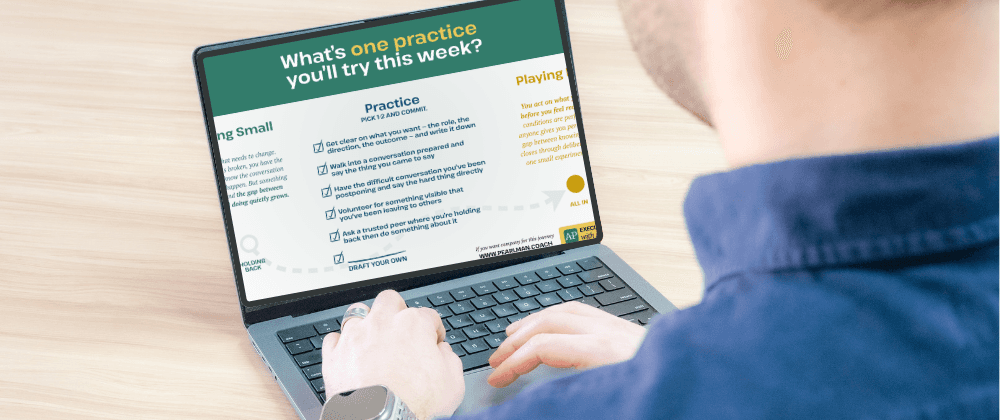
Seek reps, not perfection. Put ourselves in situations where we can try, adjust, and try again. Small risks repeated over time build more confidence than one big bet.
Build feedback loops. If our manager won’t give us honest feedback, find people who will. Mentors, peers, coaches. Someone who will look at our work and tell us the truth.
Choose who pushes us. My client thrives in athletics partly because he chooses his training partners. At work, he was randomly assigned to people who didn’t challenge him. Where you have agency over your environment, use it.
Track visible progress. Find a way to measure growth that we control. A project log, a skill tracker, a record of conversations you’ve had. Something that lets us see forward motion even when no one else is watching.
A Closing Thought
One of the things I’ve learned this year is that most people aren’t lacking in understanding—they know what’s not working and they see what needs to change.
What they’re building is nerve: the courage to act before they feel ready; the willingness to seek feedback even when it might sting; the resolve to stop waiting for confidence to arrive and start building it through practice.
If that’s the work ahead of you in 2026, you’re not alone. And you’re not starting from zero. You’re starting from every rep, every risk, and every hard conversation that got you here.
Here’s to building that nerve in 2026. Thank you for sticking with me!
Until next time,
Alex
P.S. What’s one area where your confidence has eroded? And what would it look like to rebuild it through reps instead of waiting to feel ready? Reply and tell me.
Self-reflection questions
Where do you trust yourself, and where don’t you? What's different about those two contexts?
Who in your life gives you honest feedback? If no one comes to mind, who could you ask?
What’s one small risk you’ve been avoiding that might be worth taking in January?
What would change if you stopped waiting to feel confident and started acting like someone who was?
You understand what needs to change. Ready to build the nerve to change it?
I work with ambitious leaders who know what needs to change but haven't yet built the nerve to change it. If that's you, let's talk.
Great conversations start with shared insights. My coaching practice, like this newsletter, thrives on connections. If you know someone wrestling with their confidence and navigating their sticking points, I'd love for you to share this with them.